| It was in Pretzsch that she brought up her son, who would become Elector August II, or August III as King of Poland. Though under the Queen her son grew up in the Lutheran faith, after her death his father sent him to Italy where he adopted Catholicism. She was loved and deeply mourned by the local Protestants. Hans von Kirchbach, a young nobleman studying at Leipzig's University, proposed a memorial service in the Paulinerkirche where he would deliver a valedictory address. He hired one of Bach's librettist, Johann Christoph Gottsched, to write verses for a Mourning Ode, and Bach to set these verses to music in Cantata 198, the "Trauer Ode". Bells rang all over the city of Leipzig as the ceremony took place on October 17th, 1727. |
| A patron of the arts and architecture, Augustus toured France and Italy and built fantastic baroque palaces at both Dresden and Warsaw. As Elector of Saxony, Augustus turned the Saxon capital of Dresden into a major cultural center with one of Germany’s finest art collections, attracting artists and musicians from across Europe to his court. His courts gained a fabulous reputation throughout Europe and were famous for his lavish balls. Augustus was also known as Augustus II the Strong and August II der Starke for his immense physical strength in the tradition of his ancestor Cymburgis of Masovia. Tall for the times at about 5’ 10”, he demonstrated his muscle by breaking iron horseshoes with his hands. He is also legendary for his numerous offspring, having been said to have fathered 365 or 382 children with various mistresses, only one being a legitimate heir. |
| An ambitious ruler, Augustus hoped to make the Polish throne hereditary within his family line, and to impose some order on the politically messy Polish-Lithuanian Commonwealth. Soon facing the possibility of external conquest by Sweden under their young King Charles XII, his plans for reforms had to wait and he allied himself with Imperial Russia, who financed him through the banking house of money lender Berend Lehmann. This ended up pulling Poland into the Northern War. Sweden attacked Poland, deposing Augustus who abdicated after Swedish armies entered Saxony. In 1704, the Swedes installed Augustus’s rival, Stanisław Leszczyński, on Polish throne. |
| Ultimately, Augustus regained the crown after Peter the Great reformed his army and dealt a crippling defeat to the Swedes at the Battle of Poltava. This spelled the end of the Swedish Empire and the rise of the Russian Empire. In 1709, Augustus II returned to the Polish throne under Russian auspices, making for an awkward and weak remainder of his reign. Upon his death at Warsaw in 1733, his body was interred in Poland and his heart taken to Dresden's Katholische Hofkirche. |

| The man most responsible for the Baroque beauty of the city of Dresden was Friedrich Augustus I, Elector of Saxony and King of Poland. He was born in Dresden, the second and youngest son of the Elector Johann Georg III and Anne Sophie of Denmark. Upon the unexpected death of his older brother Elector Johann Georg IV from smallpox, Augustus became Elector of Saxony as Friedrich Augustus I. of the ancient Saxon House of Wettin, a royal German dynasty which lasted longer than every other German dynasty and was in power, until 1918; for 829 years, the longest time any European house ruled a country. |
| Friedrich Augustus I, Elector of Saxony and King of Poland 1670 – 1733 |
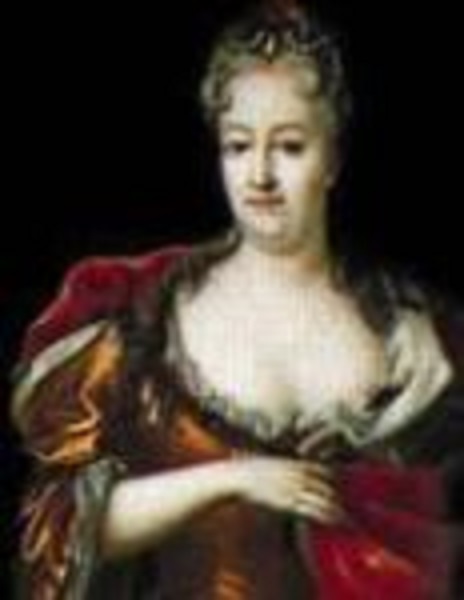
| Although Saxons were traditionally Protestant, Augustus converted to Roman Catholicism in order to be eligible for the throne of the Polish- Lithuanian Commonwealth, disgusting not only his Protestant Saxon subjects, but alienating his uncrowned wife of only four years, the Electress Christiane Eberhardine, who refused to accept her husband's actions and remained a staunch Protestant. She did not attend her husband's coronation in Poland and instead went into self-exile in Pretzsch Castle on the Elbe where she remained until her death in 1727. |
click
click