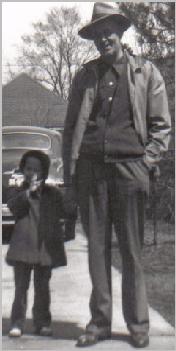
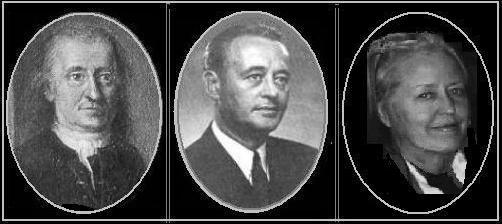
| Following this Schaitberger line since 1550, from their original mountain homeland to their life in Franconia and on to an odd little settlement in Michigan, we have watched them go down in the salt mines, up in the chimneys and settle on the farm. 400 years from when we first began our journey, in the mid-20th century, our story will end with Daniel August Schaitberger, born in Saginaw, Michigan near the turn of the 20th century at a time when the quiet country churches and quaint little settlements were fading quickly away. Above: Joseph, Daniel and Linda Schaitberger The Saginaw area had changed drastically since the days of the early settlers. Early Michigan's Gold Rush was in the "Green Gold" of the forests from the Great Lakes Region. Lumbering had quickly become the state's major industry and sawmills sprang up everywhere as lumber from Michigan replaced that from the depleted New England forests. The Saginaw area became the center of this industry with its easy access to lakes and rivers. Starting in the 1860's, Saginaw boomed. Rugged lumberjacks filled over 200 saloons on Water Street alone and drinks were sold by "pretty waiter girls" who stood in their doorways to welcome the boys when they struck town. By 1897, 160 billion board feet had been cut from Michigan's pine stand, and of this total, 31 billion board feet were taken from the Saginaw Valley Basin area, leaving Michigan's white pine forests stripped bare with the rivers and stream beds severely damaged or dried up forever and thousands of acres of dead felled trees fueling severe forest fires. Saginaw was at times a rough, noisy town, and would never again be the unique, heavily forested hamlet it once had been. It was a hard life for 45 year old Elizabeth Schaitberger, daughter of recent German immigrants, and she saw her share of hardship and misery. "Pledged" to marry Johann Simon Schaitberger at a young age, she was about to give birth to their fifteenth child. The span between her first and last child was 25 years. A humble, devout woman, her home was clean and her cooking simple. Daniel August Schaitberger was born on February 6, 1905, delivered at home on the kitchen table by his 49-year-old father who would drop dead unexpectedly five years later. By the time of Daniel's birth, the eldest of the Schaitberger siblings had already married and moved away to greener pastures. Elizabeth's children were not well schooled, and it was a subsistence survival, especially after she was suddenly widowed. The bachelor brothers who remained at home were from all reports a glum and silent lot who worked hard, drank hard and seldom laughed. Daniel was raised in this sullen atmosphere where, as the youngest, he had to grow up knowing how to defend himself. At six foot two inches tall, he was among the smaller of his big, rugged brothers who won weight lifting contests in local bars using full beer barrels. They had to be tough. This was the era of World War One, and anti-German hysteria was at a peak. Even in areas with large German populations, many people were victimized and ridiculed for their heritage well past the war's end and into the roaring twenties. This turned the world of German-Americans, including this family, upside down. Daniel, like his siblings, grew up speaking only German at home to his mother, yet as an adult, he would refuse to ever again speak German. Dan quit school in sixth grade to go to work and later took engineering classes at night at a trade school in Saginaw. It was a hard, dismal life with a great deal of loss for young Daniel, but he was setting dreams of his own and putting his sites upon a better future. |
| Country to City: The Twentieth Century |


| The Death of Germania |
| 1918 was a defining year for Saginaw's long Germanic heritage. The Saginaw Post-Zeitung, a German language newspaper since 1866, was forced to suspend its operations due to community opposition. Germania Avenue became Federal Avenue due to "negative public opinion" and Germania School, which had operated under its name for fifty years, became Lincoln School. The Board of Education demanded the immediate cessation of German language instruction in schools and removed all German material. The astute old Germania Society revised its constitution to thoroughly 'Americanize' and changed its name to the Lincoln Club. Its library, full of priceless old German books, pictures, documents and memorabilia was fully purged of "foreign" material. Even Löhe's settlements took a hit: Frankenhilf, founded long ago to help poorer Germans lead prosperous new lives, changed its name to Richville to avoid sounding "too German". To see more, follow the link on the following page to World War One Hysteria |
| There were several family deaths within a short period of time, and years of poverty, hardship and grief had taken its toll on the dwindling Schaitberger family. Daniel had ambitions that could not be met at home, and he moved, penniless but confident, to Detroit in the vibrant days of the roaring twenties. Detroit was an exciting place for a small town boy. A beautiful city at the time, Detroit had grown wealthy from the auto industry and glittered with new art deco skyscrapers and broad avenues lined with the mansions of the early industrialists. It bustled with streetcars and hummed with factory whistles. Dan's new world was a far cry from the dour dinner table where his bachelor brothers and quiet old mother ate liver dumplings in silence. Full of ambition, Dan held several small jobs while at the same time saving his money and further educating himself. He married another German-American and began a family, having found his dream with an engineering company that manufactured cranes and hoists for freighters that plied the Great Lakes and steel mills. |
| From Saginaw to Detroit |
| In time, with hard work, perseverance and the help of an equally ambitious and talented wife, he became a successful business executive, an inventor of a unique double hooked hoist and an avid investor in the stock market. Daniel's past became a dim memory. He had three children and several grandchildren. During his life, he witnessed two World Wars, a depression, prohibition and the first moon walk. He went from paying a nickel for a silent movie in a small town theater to playing the stock market. He was a man of dignity and intelligence, with impeccable grammar, a keen wit and a great sense of humor. Certainly, there was never a hint of his lack of higher education. He was tough to his core, with a lingering country boy edge about him, and yet he was sensitive and he was a dreamer, a man of great strength and determination who, against all obstacles, achieved his goals before his death in 1971. He was a Schaitberger through and through. |
| Daniel never knew much about his ancestry, and he never wanted to. Unlike some men of whom it is said, "they never forgot their humble beginnings," Dan not only intentionally forgot his, but he absolutely refused to acknowledge his roots, probably the unfortunate result of being born and raised into an ethnic culture which had been so violently assaulted, ridiculed and degraded during his life. The only clue of his past family history was an occasional far away look in his misty eyes. The task of rediscovering the Schaitberger family heritage would be left to a curious new generation who sprang from the roots so deeply hidden in the sands of undeserving shame. The Schaitberger family, like so many others, had a history of ups and downs, relocations and exile, poverty and success. The world changed remarkably during the course of Dan Schaitberger's life. As a boy, he would have been familiar with the unique "Frankonian" dialect still heard in his locale around the turn of the century. In fact, some of the local surnames were unchanged from their Salzburger roots since many of these families had come directly from Mittelfranken, where for decades Salzburger descendants had continued to intermarry. In this small pocket of Michigan's thumb, many of the settlers were completely "Salzburger" in blood and probably completely unaware of it. They were no longer considered "German-American". They were all just Americans now. |
| "Dare to be a Daniel, Dare to stand alone. Dare to have a purpose firm. Dare to make it known" |
| The Last of His Tribe |
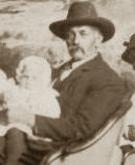
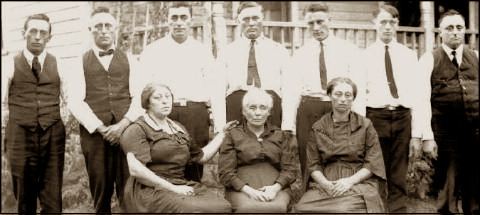
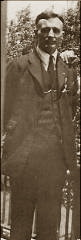
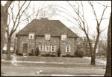
| Johann Simon Schaitberger c. 1905; Family funeral portrait 1924; Dan's childhood, adult homes |
| end of section |
| Casper Schaitberger *c1565 x? (oo 1590 Dorothea Hadl) Johann Schaitberger *1591 x 1651 (oo1618 Margaretha Moser *1596 x 1653) Hanns Schaitberger *1629 x 1679 (oo1647c. Magdalena Thanner *1625 x 1702) Joseph Schaitberger *1658 x 1733 (oo1692 Katharina Brochenberger *1670 x 1697 #2 wife) Philippus Schaitberger *1692 x 1759 (oo1712 Margaretha Beckert x 1751) Leonhard Schaitberger *1712 x 1778 (oo1748 Barbara Schorrs *1716 x c.1755 #2 wife) Tobias Gabriel Schaitberger *1749 x 1825 (oo1785 Luise Margarethe Reinlein *1741 x 1828) Johann Andreas Tobias Schaitberger *1786 x 1853 (oo1819 Margaretha Kirchner *1799 x 1874) Johann Georg Tobias Schaitberger *1819 x 1888 (oo 1850 Elizabeth Leidel *1823 x 1869 #2 wife) Johann Simon Schaitberger *1856 x 1910 (oo 1879 Elizabeth Kaufeld *1860 x 1933) Daniel August Schaitberger *1905 x 1971 (oo Rosalie *1912 x 2000): Their children (including L Schaitberger [Ruhe In Frieden]) Their grandchildren Their great grandchildren |
| Hab keine Angst, ich bin da für dich, halte deine Hand, und erinner mich. Wohin sind die Jahre und die Tage des Glücks, Sie flogen vorbei, ich halt dich fest, und schau zurück. Gedanken ziehn an mir vorbei, ich bin stolz auf unsere Zeit So wie du warst, bleibst du hier so wie du warst, bist du immer bei mir so wie du warst, erzählt die Zeit so wie du warst, bleibt so viel von dir hier. Lass los mein Freund und sorge dich nicht, ich werde da sein, für die du liebst. Jeder kurze moment und Augendbick. ich halte ihn in Ehren ganz egal, wo du bist ein ganzes Leben zieht vorbei ich bin stolz auf unsere Zeit. So wie du warst, bleibst du hier, so wie du warst, bist du immer bei mir, so wie du warst, erzählt die Zeit, so wie du warst, bleibt so viel von dir hier. Lass los mein Freund und sorge dich nicht, ich werde da sein für die die du liebst So wie du warst, so wie du so wie du warst, so wie du So wie du warst, bleibst du hier, so wie du warst, bist du immer bei mir. So wie du warst, so wie du so wie du warst, so wie du So wie du warst, so wie du so wie du warst, so wie du Lass los mein Freund und sorge dich nicht. Ich werde da sein für die die du liebst! |
| Wie versprochen liebste Linda ~ Ihr Name und unsere Geschichte wird weitergeführt ~ So wie Du warst! |